Most SEO advice starts with “build more links.” It’s not bad advice. Links are still one of the strongest ranking signals search engines use. The problem is that link building is slow, expensive, and largely outside your control — you can pitch a hundred publishers and get no replies, or you can publish one piece that earns thirty links by accident. The variance is brutal.
What gets ignored in the link-building conversation is everything else. The on-page work, the technical fixes, the content discipline, the architectural decisions — the stuff that’s entirely within your control and almost always under-invested in. We’ve audited sites that spent twelve months chasing backlinks while ignoring a robots.txt rule that was blocking half their content from being indexed. The link-building budget bought less traffic than ten minutes of fixing the indexation issue would have.
This post is the playbook for everything you can do without sending a single outreach email. Ten ways to grow organic traffic that depend on your team, your site, and your discipline — not on a publisher’s willingness to link to you. Most businesses that feel “stuck” on SEO are stuck because they’ve ignored at least seven of the ten.
1. Fix the Technical Foundation Before Anything Else
Nothing else on this list matters if search engines can’t crawl, render, and index your site properly. Technical SEO is the unsexy work that has the highest ceiling — fix a serious indexation issue and the traffic curve can move within weeks, with no new content written.
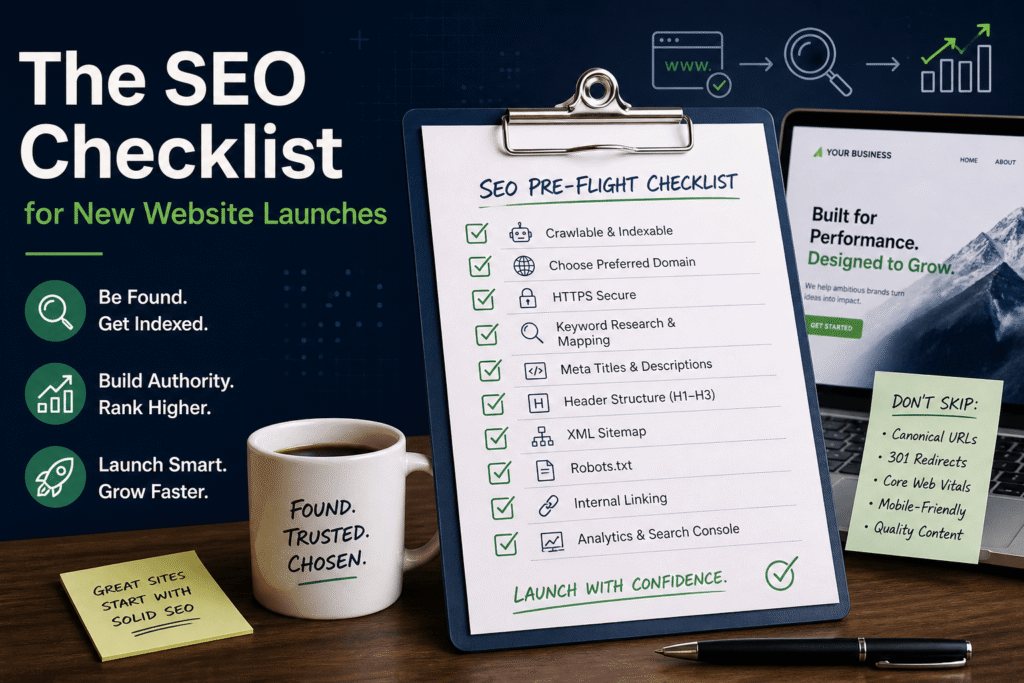
The first audit any new site needs is a crawl. Use Screaming Frog, Sitebulb, or a similar tool to map every URL on the site and look for the obvious failure modes: broken links, redirect chains, pages returning the wrong status codes, duplicate content variants, missing canonicals, mismatched hreflang, and pages accidentally blocked by robots.txt or noindex tags. Each of those issues is a small leak. Together, they often explain why a site that “should be ranking” doesn’t.
Schema markup is the other technical lever most teams underuse. Adding structured data — Article, Product, FAQ, LocalBusiness, BreadcrumbList — tells search engines exactly what each page is about and unlocks rich results that take up more space in the SERP. A page with FAQ schema can occupy three or four times the vertical space of a plain blue link. That’s screen real estate competitors didn’t claim because they skipped a fifteen-minute implementation.
The point of technical SEO isn’t perfection. It’s removing the obstacles between your content and the search engine. Once those are out of the way, everything else on this list works harder.
2. Win Core Web Vitals — Speed Is a Ranking Signal Now
Page speed used to be a soft factor. It’s been a confirmed ranking signal since 2021, and the bar has only gone up. Google’s Core Web Vitals — Largest Contentful Paint, Interaction to Next Paint, and Cumulative Layout Shift — measure whether your site is fast enough, responsive enough, and stable enough for users to actually use it.
A site that fails Core Web Vitals isn’t just losing rankings. It’s losing visitors before the page finishes loading. Roughly half of mobile users abandon a page that takes more than three seconds to render. Every second you cut from your load time recovers conversions you didn’t know you were losing.
The work here is concrete and well-documented. Compress images and serve them in modern formats. Defer non-critical JavaScript. Eliminate render-blocking CSS where possible. Use a CDN. Lazy-load below-the-fold content. Cache aggressively. Audit your third-party scripts and remove the ones nobody can justify keeping. Each of those changes is a small win on its own. Combined, they routinely turn a 4-second site into a sub-2-second one without rebuilding a thing.
The benefit isn’t just SEO. Faster sites convert better, retain users longer, and cost less to advertise on (because Google rewards fast pages with lower CPCs in paid search). Performance work is one of the few investments that pays off in three different budgets at once.
3. Match Search Intent Precisely — Rankings Follow
The biggest content mistake teams make isn’t writing badly. It’s writing the wrong type of content for the keyword they’re targeting. A keyword like “best CRM” implies a comparison list. A keyword like “what is a CRM” implies a definition. A keyword like “Salesforce login” implies a transactional shortcut. Each of those queries needs a different page format, even though all three contain the word “CRM.”
Search intent is the single most underweighted factor in SEO content strategy. Look at the existing top-ranking pages for any keyword you’re targeting. If the top ten results are all comparison tables, you’re not going to outrank them with a thousand-word essay, no matter how well-written. Google has already decided what kind of answer this query deserves. Your job is to be the best version of that answer, not a different kind of answer entirely.
The practical workflow is straightforward. Search the keyword. Read the top five results. Note their format, their depth, their structure. Notice whether they cluster around informational, transactional, navigational, or commercial intent. Then build something that fits that cluster — and is better than what’s already there. “Better” usually means more thorough, more specific, more current, or more authoritative. Sometimes it means more concise. The point is that you’re competing within a defined format, not inventing a new one.
This single shift — from “what do I want to write?” to “what does the searcher expect to find?” — is the difference between content that ranks and content that quietly dies on page seven.
4. Build Topical Authority Through Content Clusters, Not Isolated Posts
Search engines reward depth. A site with thirty pages on different topics, each shallow, will lose to a site with thirty pages on one topic, each deep — almost every time. The reason is signal clarity. Google can confidently say “this site is the authority on subject X” when the entire content footprint reinforces that claim. It can’t say much about a site that publishes a little bit of everything.
The cluster model is how this works in practice. Pick a small number of core topics — three to five — that your business genuinely has authority on. For each one, build a “pillar page” that comprehensively covers the topic at a high level. Then build a network of “cluster posts” that each go deep on a specific subtopic, all linking back to the pillar and to each other.
The result is a tightly interconnected body of content that signals topical mastery to search engines and creates a navigation structure that keeps human readers on the site. A visitor who lands on a cluster post sees the pillar page in the related links, clicks through, and is now reading three pages instead of one. That depth of engagement is itself a ranking signal.
The discipline is in resisting the urge to chase every adjacent topic. A site that goes deep on three subjects will outperform a site that goes shallow on twenty, both in rankings and in conversion. Saying no to off-topic content is harder than it sounds, but it’s where authority is actually built.
5. Refresh and Prune the Content You Already Have
The fastest organic traffic gains in most businesses come from content that already exists. Not new posts. Old ones. Pages that were published two years ago, ranked briefly, and then drifted as competitors updated theirs. Refreshing those pages — updating the data, adding new sections, sharpening the headline, improving the structure — often produces bigger ranking gains than publishing a new piece, at a fraction of the effort.
The exercise is simple. Pull a list of every page on your site that drives organic traffic. Identify the ones whose rankings have slipped, whose content is outdated, or whose conversion rate has declined. Update them systematically. New stats, new examples, new sections covering questions that didn’t exist when the post was first published, current screenshots, fixed broken links. Then republish with the original URL preserved.
Pruning is the other half of this discipline. Pages that have never ranked, never earned traffic, and aren’t likely to should be either substantially upgraded or removed. Sites with hundreds of thin, low-value pages dilute their own authority — Google sees a site that publishes a lot of mediocre content and concludes that the site is mediocre. Cutting the dead weight concentrates authority on the pages that actually deserve it, and rankings on the surviving pages often improve as a direct result.
This is unglamorous work. It doesn’t feel like progress. It produces some of the most reliable SEO gains you’ll ever see.
6. Engineer Your Internal Linking Like It Matters — Because It Does
Internal links are the most controllable and most underused ranking lever available. They cost nothing. They require no outreach. They distribute authority from your strongest pages to the ones you want to rank next. And most sites’ internal link structures are accidental — whatever the writer happened to remember linking to in the moment they wrote the post.
The discipline here is to treat internal linking as a deliberate part of the content workflow. Every new post should link to at least three to five other relevant posts on the site. Every existing post should be reviewed periodically and updated to link to newer related content. Pages you specifically want to rank — your pillar pages, your money pages — should accumulate the most internal links from across the site, because that’s how you tell Google “this is the most important page on this topic.”
Anchor text matters too. Linking to a page with the anchor “click here” does nothing for that page’s ranking. Linking with descriptive, keyword-relevant anchor text passes both the link equity and the topical signal. “Our guide to headless CMS architecture” is a better anchor than “this article.”
The compounding effect is real. A site that adds five thoughtful internal links to every new post will, over a year, build a dense internal graph that boosts every page in the network. The work is small and continuous. The result is a site that ranks better as a whole than any individual page would on its own.
7. Capture Featured Snippets and Position Zero
The featured snippet — the answer box that appears above the regular search results — is the highest-leverage organic spot on the SERP. It captures more clicks than the first organic result on queries where it appears. It’s also the answer most often surfaced by voice assistants and increasingly by AI-powered search interfaces. Earning it is functionally equivalent to skipping the queue.
The good news is that featured snippets are formulaic. Google selects content that directly answers the question, in a structure the algorithm can parse. Definitions get pulled from concise paragraph answers. Process queries get pulled from numbered lists. Comparison queries get pulled from tables. If you know the format Google prefers for a given query, you can structure your content to match.
The approach is methodical. Identify keywords where your site already ranks in positions two through ten — these are the queries where you have the best chance of jumping into the snippet. For each one, look at the current snippet (if there is one) and ask: can we answer the question more clearly, more concisely, or more comprehensively? If yes, restructure the relevant section of your page to do exactly that. Use the format Google clearly prefers. Add a direct, well-structured answer near the top of the page where the snippet is most likely to be pulled from.
It’s not magic, but it’s close to it for the queries where it works. A page that moves from position three to position zero typically sees its click-through rate double or triple — without the URL changing or any new links being earned.
8. Optimize Titles and Meta Descriptions for Clicks, Not Just Rankings
Ranking is half the game. The other half is getting the click once you’re ranked. A page in position three with a great title can outperform a page in position one with a weak one, because click-through rate itself is a ranking signal — Google notices when users consistently choose your result over competitors and rewards that behaviour with better positions over time.
Most title tags on the web are formulaic. They contain the target keyword, the brand name, and not much else. There’s a real opportunity in being more deliberate. A great title does three things: it includes the keyword (so it ranks), it makes a clear promise (so it earns the click), and it differentiates from the other nine titles on the page (so it stands out in the scan).
Meta descriptions don’t directly affect rankings, but they heavily affect click-through rate. Treat each one as a one-sentence pitch. State the value, address the most common objection, and give the reader a reason to click your result instead of the four others sitting next to it. Generic descriptions (“learn more about X with our comprehensive guide”) get skipped. Specific, benefit-led descriptions get the click.
The quick win is auditing your top 20 ranking pages and rewriting any title or description that’s purely descriptive. Even small CTR improvements compound — a page getting twice the clicks at the same ranking is, for practical purposes, ranking twice as high.
9. Treat Images and Video as Ranking Surfaces, Not Decoration
Most teams optimise their text and ignore everything visual. That’s a missed opportunity, because Google Images, Google Lens, and increasingly Google’s video search are all surfaces where less competition exists for the same audience. A well-optimised image can drive substantial traffic on its own, particularly in industries where buyers research visually — interiors, fashion, food, travel, real estate, design, products of any kind.
Image optimisation is mostly mechanical. Use descriptive, keyword-relevant filenames. Write proper alt text that describes the image accurately (this also helps accessibility, which is increasingly a ranking factor in its own right). Compress images so they load fast, but don’t compress them so aggressively that they look bad. Provide captions where they add value. Add structured data for images on pages where it’s relevant, particularly product pages.
Video deserves similar attention. A YouTube video embedded on a relevant page can pull traffic both to the page and to the video itself, and YouTube videos increasingly appear directly in regular Google search results — sometimes above the organic listings. Videos with clear titles, descriptions, transcripts, and chapter markers rank better and convert better than uploads with default metadata.
The investment is modest. The ceiling is high. And almost nobody in your category is doing this well, which is exactly why it works.
10. Earn Local Visibility Through Google Business Profile and Brand SERPs
If your business has any geographic relevance — a physical location, a service area, regional clients — Google Business Profile is one of the highest-ROI assets you’ll ever set up. It’s free, it appears at the top of local search results, and it captures roughly a quarter of all interactions with the business listings it dominates.
The basic setup is straightforward but takes more discipline than most businesses give it. Claim and verify the profile. Fill out every field, not just the obvious ones — categories, hours, services, attributes, photos. Keep the information current. Post regular updates. Respond to every review, positive or negative. Add photos consistently. Each of those signals tells Google the profile is actively maintained, which directly affects how often it gets shown.
The second piece is the brand SERP — what shows up when someone Googles your company name directly. This is the search result that customers, investors, partners, and journalists are most likely to see, and it’s where first impressions are formed. Owning the first page of results for your own brand name means actively optimising your homepage, your About page, your Wikipedia entry (if one exists), your LinkedIn presence, your Knowledge Panel, and any third-party profiles that surface in those results. None of this requires link building. All of it requires deliberate attention.
For local businesses, the combination of a well-maintained GBP and a clean brand SERP can produce more traffic and more conversions than every other tactic on this list combined. It’s the lowest-effort, highest-return work in the playbook for any business with a defined geography.
The Compounding Effect
None of these ten tactics is a silver bullet on its own. Together, they’re the entire playbook for sustainable organic growth without external dependencies. A site that systematically works through this list — fixing the technical foundation, winning Core Web Vitals, matching intent, building clusters, refreshing content, engineering internal links, capturing snippets, optimising titles, taking visual content seriously, and owning the local layer — will outperform a site that does none of them, even if the latter spends ten times more on link building.
The honest truth about SEO is that link building gets all the attention, but on-page and technical work do most of the actual work. The reason most teams skip them is that they’re harder to brag about. There’s no glamorous case study in “we fixed our internal linking structure and rankings improved.” But the rankings improved.
The Bottom Line
You don’t need a link-building budget to grow organic traffic. You need a checklist, a calendar, and the discipline to work through it without expecting overnight results. Every item on this list compounds with the others, and most of them are entirely under your control — no outreach, no negotiation, no dependency on anyone else saying yes.
Start with the technical fixes, because nothing else works without them. Move to content discipline next, because that’s where the bulk of your traffic will eventually come from. Then optimise the surfaces — snippets, titles, images, local — that turn rankings into clicks and clicks into customers.
Do this for twelve months without quitting and you’ll have a site that outranks competitors who outspend you. That’s the part of SEO that doesn’t require a single backlink to work.

Bojan Zlatanović
Founder at Norvaris. Building digital products and writing about what actually works in product, engineering, and growth.
More from this author