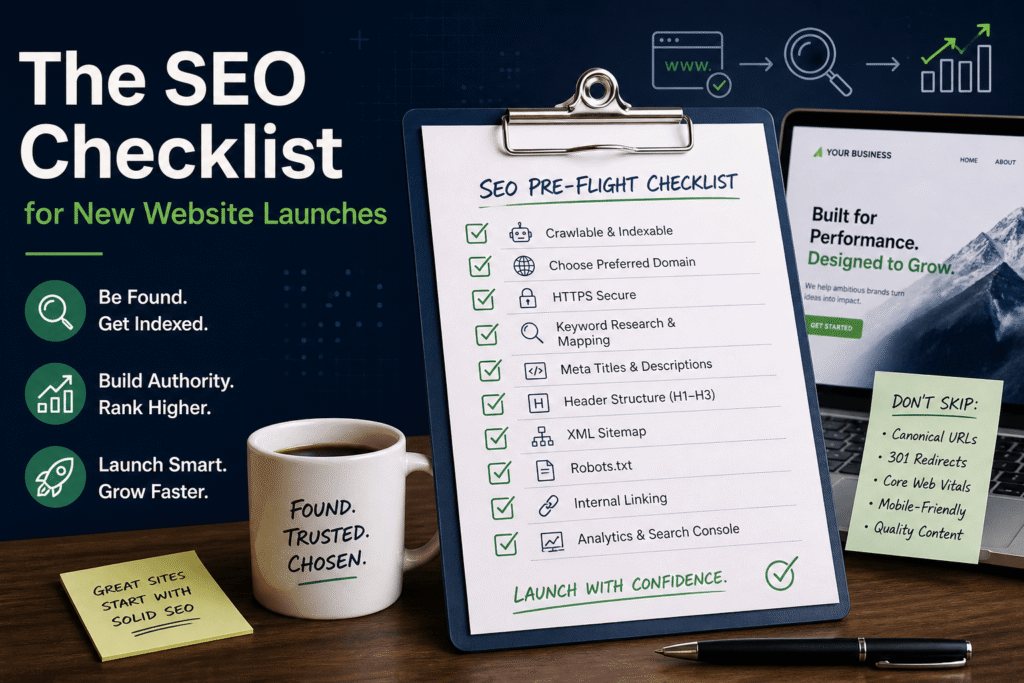
Most business owners know they “should be doing SEO.” Few of them can explain what that actually means, how it would change their business if it worked, or what it would cost them if they kept ignoring it.
That gap is where most of the bad decisions happen. SEO gets treated as a vague marketing chore — something the agency mentioned, something a competitor seems to be doing, something to “look into next quarter.” Meanwhile, the customers who would have bought from you are typing their problem into a search bar, finding three competitors who showed up first, and never knowing your company existed.
This is the part of the conversation that doesn’t make it into the marketing report. SEO failures are invisible. There’s no error message when a buyer doesn’t find you. There’s no notification when a competitor wins the click that should have been yours. The traffic you didn’t get doesn’t show up in your analytics, because the visitor never arrived. And because the failure is silent, it’s easy to assume nothing is wrong.
It is wrong. And the longer you leave it, the more expensive it gets to fix.
What SEO Actually Is — And Isn’t
Search engine optimization is the work of making your website easy for search engines to find, understand, and recommend to people looking for what you offer. That’s the entire definition. Everything else is implementation detail.
What SEO is not: a hack, a trick, a way to game an algorithm, or a thing your nephew can do on weekends. The version of SEO that worked in 2010 — keyword stuffing, blog post farms, link exchanges with sketchy directories — is a liability now. Modern search engines, including the AI-powered ones that have arrived in the last two years, are sophisticated enough to penalise that approach faster than it can produce results.
Modern SEO is closer to a discipline than a tactic. It combines technical engineering (making sure search engines can crawl and index your site), content strategy (creating pages that answer the questions your customers actually ask), authority building (earning citations and references from places search engines trust), and user experience (building a site that visitors stay on and come back to). Each of those pillars reinforces the others. You can’t compensate for a broken site with great content, and you can’t compensate for thin content with a fast site.
Done well, SEO becomes the most durable acquisition channel a business can have. Done poorly, it’s invisible noise. Done not at all, it’s a slow leak in your top of funnel that you’ll feel for years before you fully understand the cost.
Why SEO Matters More in 2026 Than Ever Before
It’s tempting to assume that the rise of AI search has made traditional SEO obsolete. The opposite is true. The mechanics have shifted, but the underlying logic — content that earns trust gets surfaced; content that doesn’t, gets buried — is more important now, not less.
When someone asks ChatGPT, Claude, Gemini, or Perplexity for a recommendation, the answer doesn’t come from nowhere. The model pulls from sources. It cites companies whose content has accumulated authority across the web. The companies that show up in those answers are, almost without exception, the same companies that rank well in traditional search results. Strong SEO and strong AI visibility are produced by the same work. There is no separate “AI optimization” that bypasses the discipline of being a credible, well-linked, well-structured source on the topics you sell.
This is the part most teams haven’t internalised yet. The audience asking AI for recommendations is the same audience that used to type the question into Google — and the businesses that earn the answer are the ones that did the SEO work years before the model started training on the web. Catching up after the fact is possible, but it’s substantially harder than it would have been to start when the rest of your competitors were starting.
The other shift is buyer behaviour. The average B2B buyer now does more than two-thirds of their research before they ever contact a vendor. They form their shortlist based on what they read, what they find, and what they trust — and most of that happens in search. By the time you get a sales conversation, you’re either on the shortlist or you’re not, and the shortlist was built by SEO whether you participated in it or not.
The Compounding Argument Nobody Makes
Here’s the case for SEO that paid advertising can never match: every dollar you put into SEO continues to work after you stop spending it. Every dollar you put into paid ads stops working the second the budget runs out.
A blog post that ranks on the first page of Google for a relevant keyword can generate qualified visitors every day for years. The work was done once. The cost was paid once. The traffic keeps coming. A paid ad campaign at the same scale, producing the same volume of traffic, would require continuous spend forever — and the moment you pause, the traffic disappears.
This is why SEO is, eventually, the cheapest channel a business can run. Not in the first month. Not even necessarily in the first year. But at month thirty-six, the company that has been investing consistently in SEO is sitting on an asset — a portfolio of pages that rank, generate qualified traffic, and convert without ongoing media cost — that the company relying entirely on paid acquisition does not have. The compounding gap between those two companies is enormous, and it’s almost entirely invisible until you compare them side by side.
The reason most companies don’t make this investment is that the compounding only happens if you stay disciplined for long enough to feel it. The first six months of SEO are uncomfortable. The traffic curve is flat. The investment looks like a cost, not an asset. Teams without conviction quit at month four, just before the curve starts to bend. The teams that hold the line are the ones who end up dominating their category two years later.
SEO Is the Trust Layer
Ranking high in search isn’t just a traffic mechanic — it’s a credibility signal. When a potential customer searches for a service, they assume the top results are the most reputable options in the space. That assumption is largely correct, because it takes consistent quality and time to earn a top ranking. People know this intuitively, even if they couldn’t explain it.
This trust effect compounds with everything else you’re doing. A buyer who finds you in the top three results, then sees your brand mentioned in a relevant article, then visits your site and finds it fast and well-designed, has just gone through three independent positive signals before they ever heard a sales pitch. By the time they fill out the contact form, they’ve already half-convinced themselves you’re the right choice. That’s a much shorter sales cycle than starting from cold.
The opposite is also true. A buyer who can’t find you in search assumes you’re either too small to take seriously or too new to trust. Whether that assumption is accurate is irrelevant — they make it in seconds, and they don’t ask for your side of the story. Search rankings are how strangers decide whether your business is real.
Who Genuinely Needs SEO (And the Few Who Don’t)
The honest answer is that nearly every business with an online presence benefits from SEO, but the urgency varies.
Service businesses with a defined geography — law firms, dental practices, contractors, agencies — need SEO more than almost any other category. Local search has become the default way people find these services. The phone book is gone. The yellow pages are gone. What replaced them is “[service] near me” typed into a phone, and the businesses that own those rankings own a steady, durable stream of new customers.
E-commerce businesses live or die on search visibility. Product searches happen on Google before they happen on the retailer’s own site. If your product pages don’t rank, your products effectively don’t exist outside your existing customer base. Every category-level keyword you don’t own is revenue going to a competitor who optimised their PDPs while you didn’t.
B2B SaaS and professional services depend on SEO for the research-heavy buying journey we described earlier. The buyer is going to learn before they buy. Every piece of educational content that ranks is a chance to be the company that taught them — and the company that taught them is, statistically, the company they buy from.
Content businesses, media, and creators have SEO as their primary revenue mechanic. Without organic traffic, the model doesn’t work.
The category that genuinely doesn’t need much SEO is small. It includes businesses that operate exclusively through referral, businesses that sell into a tiny known market where every potential buyer already knows about them, and businesses with strong proprietary distribution channels that don’t depend on search. If you’re not in one of those niches — and almost nobody is — SEO is not optional. It’s a question of when, not whether.
When SEO Becomes Urgent, Not Just Important
Some moments raise the stakes. SEO matters every day, but these are the points where neglecting it becomes actively expensive.
At a website launch or rebuild. Every URL change, every site migration, every CMS swap is a chance to lose hard-earned rankings if the technical SEO isn’t handled carefully. Sites that get rebuilt without an SEO plan routinely lose 30-60% of their organic traffic in the months after launch — traffic that took years to build. The remediation work is doable but expensive, and it’s almost always cheaper to do it right the first time.
When entering a new market or vertical. A company expanding into a new geography or product line needs visibility in that new space. Existing brand equity doesn’t transfer automatically. A new market means new keywords, new competitors, new content needs, and a fresh authority curve to climb.
In competitive industries where the top three results capture most of the clicks. SEO research consistently shows that the first organic result gets roughly 25-30% of clicks, the second around 15%, and the third around 10%. Position four onwards splits a smaller share of an already smaller pie. If you’re in an industry where competitors are actively investing in SEO, ranking outside the top three is functionally similar to not ranking at all.
When paid media costs are climbing. The cost per click for competitive keywords has risen consistently for years. Companies that built strong organic positions early are insulated from those rising costs. Companies that didn’t are paying more every quarter for the same volume of traffic — a treadmill that gets faster the longer you stay on it.
When you’re preparing to raise capital or sell. Investors and acquirers look at organic traffic as a proxy for brand strength and pipeline durability. A business that depends entirely on paid acquisition gets valued lower than an equivalent business with strong organic visibility, because organic is more defensible. SEO directly affects valuation.
The Cost of Doing Nothing
Most arguments for SEO emphasise the upside — more traffic, more leads, more revenue. The harder argument is the downside, because the downside is invisible.
Think of it this way. Every month your competitors invest in SEO and you don’t, they accumulate authority — links, citations, content depth, search history — that compounds. The gap between you and them widens, slowly but consistently. After two years, that gap may be too wide to close without a much larger investment than the one you avoided. The “we’ll do SEO later” decision is rarely framed as “we’re choosing to make SEO three times more expensive when we eventually start.” But that’s what it usually means.
There’s a second cost that doesn’t show up in any spreadsheet — the customers who had the problem you solve, searched for it, and found someone else. That visitor never reaches your site. They never hear your pitch. They become someone else’s customer, often for years. The lifetime value of every one of those buyers is a real number, even if it doesn’t feel like one because you never knew they existed.
What Good SEO Looks Like (And the Spam Version You Should Avoid)
The SEO industry has a reputation problem because, for two decades, large parts of it operated on tactics that genuinely were spammy. Buying links from offshore networks. Stuffing pages with keyword variations until they were unreadable. Generating hundreds of low-quality blog posts to game algorithms. Some agencies still operate this way. Some are switching to AI-generated content farms that achieve the same effect at lower cost.
None of this works any more, and it’s increasingly likely to do active damage. Google’s recent algorithm updates have been targeted specifically at low-effort, mass-produced, AI-spun content. Sites that relied on those tactics have lost most of their traffic over the last two years. The trajectory is one-way — search engines are getting better, not worse, at distinguishing genuine quality from manufactured volume.
Real SEO looks different. It looks like a small number of substantial, authoritative pages on each topic, written by people with actual expertise. It looks like a clean, fast, well-structured site that serves users before it serves crawlers. It looks like a content strategy aligned with what your customers genuinely want to know, not a list of keywords with arbitrary search volume targets. It looks like patient, consistent investment over years rather than aggressive shortcuts over months.
The difference between the two approaches is the difference between owning a piece of property and renting a billboard on a road that may not exist next year.
How to Know Whether It’s Working
The honest measurement of SEO health isn’t ranking position on a single keyword. It’s the trend of organic traffic to pages that drive business outcomes — leads, signups, purchases, demos, whatever your conversion event is.
A few things to watch:
The total volume of organic traffic over time, ideally trending upward across quarters rather than weeks. Week-to-week SEO data is noisy. Quarter-to-quarter data is meaningful.
The diversity of keywords driving that traffic. A site getting most of its traffic from one or two terms is fragile — a single algorithm update can wipe out a quarter’s revenue. A site with traffic spread across hundreds of relevant queries is durable.
The conversion rate of organic visitors compared to paid. Healthy SEO usually produces higher-converting traffic, because the visitor was already searching for something specific.
The behaviour of the traffic on your site. If organic visitors land, scan, and leave within seconds, the rankings aren’t matched to genuine intent. If they land, read, click through, and convert, the SEO is doing real work.
None of these metrics tell the whole story alone. Together, they give a much more honest picture than any single ranking report.
The Bottom Line
SEO isn’t a marketing channel. It’s the way most strangers will form their first opinion of your business. That opinion is being formed every day, whether you’re investing in it or not — and the version of you that shows up in search results is the version those strangers will trust, judge, and either buy from or ignore.
The companies that dominate their categories online didn’t get there by accident, and they almost never got there with paid ads alone. They built durable, compounding visibility across the topics their customers care about, over years, with the kind of patience that most businesses lack. The cost of starting is real, and the timeline is longer than anyone wants. But the cost of not starting is larger, even though it’s harder to see.
If your business has a website and customers who use search — which is to say, almost every business — SEO isn’t a nice-to-have. It’s the foundation under everything else your marketing is trying to do. Build it deliberately, build it patiently, and you compound. Skip it, and you’re paying for traffic forever while watching competitors who started earlier own the space you should have been in.
The best time to start was three years ago. The second-best time is now.
Most of this is decided during the build, not after it. Site structure, page speed, heading hierarchy and internal linking are architecture decisions, and retrofitting them into a site that was built without them costs more than doing it properly the first time. That groundwork is part of every project — see business website design and development, or send us your current site and we’ll tell you what’s holding it back.

Bojan Zlatanović
Founder at Norvaris. Building digital products and writing about what actually works in product, engineering, and growth.
More from this author