The Minimum Viable Product changed how startups build software. Ship something small, test it, iterate. The idea was simple and powerful: don’t build what you don’t know people want.
But somewhere along the way, “viable” became an excuse for “barely functional.” Teams started shipping products that technically worked but that nobody wanted to use twice. The MVP had become a liability. Founders would point to a low-quality release and call it a “learning experience,” then wonder why none of the learnings translated into a second wave of engaged users. The product had technically launched. Nobody had technically stayed.
Enter the Minimum Lovable Product.
What Went Wrong with the MVP
The original MVP concept, as described by Eric Ries, was about validated learning. Build the smallest thing that lets you test an assumption about your market. It was never meant to be your product — it was meant to be a test.
But in practice, many teams treat the MVP as the product. They ship something half-baked, measure signups (not retention), declare success, and move on to adding features. Meanwhile, the users who signed up never come back because the experience was forgettable. The term “minimum viable product” became a permission slip — a reason to publish work that the team knew wasn’t good yet, and to interpret every signup as a vote of confidence rather than a polite click.
The MVP tests whether people will try your product. It doesn’t test whether they’ll stay. And in a world where the cost of trying something new is close to zero — free trials, one-click signups, pay-as-you-go — the only signal that actually matters is whether people come back.
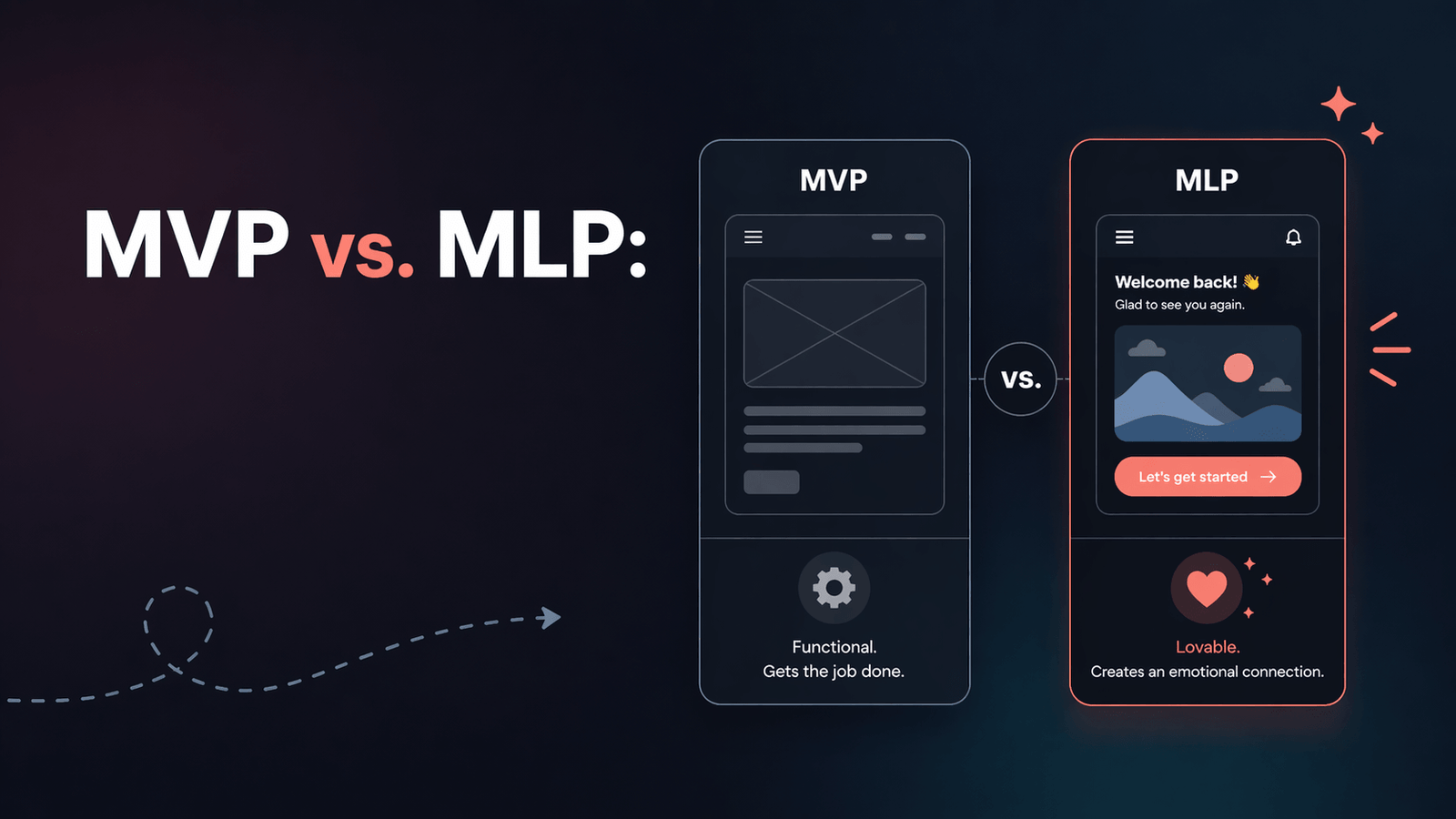
The Minimum Lovable Product (MLP)
An MLP is the smallest product that makes users genuinely happy. Not just willing to use it — happy enough to come back, tell someone about it, and integrate it into their workflow. That last word matters more than the others. A lovable product doesn’t just get used; it earns a place in someone’s week. It becomes the tool they open first, the tab they don’t close, the thing they reach for without thinking.
The difference between the two philosophies is subtle but critical:
| MVP | MLP | |
|---|---|---|
| Goal | Test if the idea works | Test if users love the experience |
| Success metric | Signups | Retention + referrals |
| Quality bar | Functional | Delightful in at least one dimension |
| UX priority | Low — get it working | High — make the core flow feel great |
| Scope | Minimum features | Minimum features, maximum polish on what’s included |
An MLP doesn’t have more features than an MVP. It has the same features, done better. That’s the part that trips teams up — the instinct, when you’ve built something and it’s not landing, is to add. More features, more integrations, more surface area. The MLP mindset says the opposite. If a product isn’t loved at three features, adding a fourth won’t fix it. Go deeper, not wider.
Why This Matters More Than Ever
In 2026, user expectations are higher than they’ve ever been. People use Notion, Linear, Figma, and Arc every day. They know what good software feels like. Shipping something that “works” but feels clunky is no longer enough to get users to engage.
This is a compounding problem. Each generation of well-designed tools raises the baseline for what “normal” feels like. A product that would have seemed polished five years ago feels dated today. Keyboard shortcuts that used to be power-user features are now expected on day one. Loading states, empty states, undo, offline behaviour — all of these are now part of the minimum bar, not the delight layer.
Your first impression is your only impression. If the first experience is forgettable, users won’t come back to see version 2. And because acquisition is more expensive than it’s ever been — paid channels saturated, organic harder to earn — burning a first impression is a genuinely costly mistake. You’re not just losing that user; you’re losing the cost of acquiring them, plus the compounded effect of the referrals they never made.
How to Build an MLP
1. Pick One Thing to Be Great At
An MLP doesn’t need to be great at everything. It needs to be great at one thing — the core action that defines your product.
If you’re building a project management tool, the task creation and management experience needs to feel effortless. If you’re building an analytics dashboard, the data visualization needs to be beautiful and fast. Everything else can be basic. Settings can look plain. Account management can be minimal. The admin interface can be ugly. What cannot be ugly is the thing your users do ten times a day.
Picking your one thing is harder than it sounds, because every team thinks their product is about more than one thing. It isn’t. If you ask a happy user what they love about your product, they will answer with a single sentence. That sentence is your one thing. Everything else is supporting cast.
2. Obsess Over the Core Flow
Map the journey from signup to the “aha moment” — the point where the user understands the value. Then make every step in that journey as smooth and fast as possible.
Remove unnecessary steps. Pre-fill what you can. Make the UI intuitive enough that instructions aren’t needed. Time how long it takes a new user to reach value. Then cut that time in half.
Record yourself going through your own onboarding with fresh eyes. Every pause, every moment of uncertainty, every “wait, where is…” is a friction point that a new user will hit harder than you. The best teams watch these recordings with a kind of painful honesty — they don’t explain why the friction exists, they just note where the user slowed down and go fix it.
3. Design Matters from Day One
This doesn’t mean you need a design system or custom illustrations. It means:
- Typography should be readable and consistent
- Spacing should feel intentional, not random
- Colors should guide attention, not distract
- Interactions should respond instantly with clear feedback
Good design isn’t decoration. It’s communication. It tells users “we thought about this” — and that builds trust. Users can’t always articulate why one product feels credible and another feels amateurish, but they can feel it within seconds, and they act on that feeling before any rational evaluation of features.
4. Cut Features, Not Quality
If you have to choose between three mediocre features and one excellent one, choose one. Users remember quality. They don’t remember feature checklists.
The hardest part of building an MLP is saying no. No to the feature that “would be easy to add.” No to the integration that “only takes a day.” Every addition dilutes your focus. And the cost of a new feature is never just the time to build it — it’s the maintenance burden, the testing surface, the support questions, the edge cases, and the cognitive load on every user who has to learn that the thing exists. “It’s just a small feature” is almost always wrong.
5. Measure Love, Not Just Usage
The metrics that matter for an MLP are different from MVP metrics:
- Retention rate: Do users come back after day 1? Day 7? Day 30?
- Net Promoter Score: Would users recommend this to a colleague?
- Time to value: How quickly do users reach the “aha moment”?
- Organic referrals: Are users telling others without being asked?
If users sign up but don’t return, your product is viable but not lovable.
When MVP Still Makes Sense
The MVP approach isn’t dead — it’s just not sufficient by itself. MVPs still make sense when:
- You’re testing a fundamentally new market hypothesis
- The target audience is technical and tolerant of rough edges
- You need to validate demand before investing in quality
- You’re running a time-boxed experiment with a clear success/failure criteria
But once you’ve validated that the market exists, the next step isn’t “add more features.” It’s “make the existing features lovable.”
The Bottom Line
The minimum viable product tests your idea. The minimum lovable product tests your execution. Both are necessary, but too many teams stop at viable and wonder why nobody sticks around.
Build less. Build it better. Make the first experience so good that users can’t imagine going back to the old way. The products that end up defining their categories — the ones people describe as “the only tool I actually enjoy using” — were never the most feature-complete at launch. They were the most considered. The team cared about details that nobody asked about, and users felt that care the moment they opened the app.
That’s the MLP. And it’s the difference between a product that launches and a product that lasts.

Bojan Zlatanović
Founder at Norvaris. Building digital products and writing about what actually works in product, engineering, and growth.
More from this author